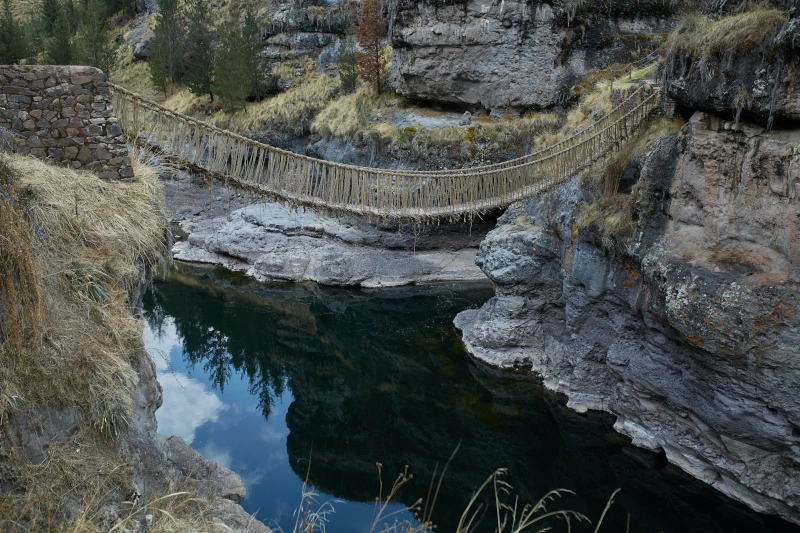
Nestled in the scenic Peruvian landscape lies an awe-inspiring testament to Inca engineering – the Qeswachaka Inca Bridge. This hand-woven grass bridge, suspended high above the roaring Apurimac River, embodies the Inca people’s resilience and ingenuity. The survival of this impressive structure into the 21st century provides a tangible link to a civilization long past.
The creation of the Qeswachaka Inca Bridge is a tale of skilled craftsmanship and deep-rooted community collaboration. Every year, local communities come together to painstakingly rebuild the bridge, maintaining an ancient tradition that spans generations. This ongoing ritual symbolizes the enduring strength of human unity in the face of adversity.
The Qeswachaka Inca Bridge, an integral part of the Inca Road System, is a spectacular sight. It stands as an ancestral relic, linking Peru’s past with its present. This engineering marvel is unique, carrying a weight of rich cultural heritage and history.
Carved into the rugged Andean landscape, the Inca Road System was the backbone of the Inca Empire. This extensive network of roads connected remote corners of the vast empire. The Qeswachaka Inca Bridge was a critical piece of this infrastructure, allowing safe passage across the perilous Apurimac River.
Constructed entirely from local grasses, the bridge’s design remains largely unchanged since Inca times. This engineering marvel stretches nearly 28 meters (91 feet) long and dangles precariously 15 meters (49 feet) above the roaring river. The survival of the bridge into the modern era is nothing short of remarkable.
Interestingly, this ancient masterpiece exists in contrast to another famous Inca path: the Inca Trail to Machu Picchu. Both were vital parts of the Inca Road System, yet they differ significantly. The Inca Trail to Machu Picchu is famous worldwide, while the Qeswachaka Inca Bridge often remains overlooked.
The local Quechua-speaking communities see the Qeswachaka Inca Bridge as a vital connection to their past. They maintain and rebuild the bridge annually as part of a time-honored tradition. This act of renewal serves to strengthen communal bonds and honor their Inca ancestry.
The Qeswachaka Inca Bridge is much more than an ancient relic. It embodies the technical prowess of the Incas, an intricate part of their road system. It also holds great cultural significance for the Quechua-speaking communities, as a direct link to their Inca heritage.
The Qeswachaka Inca Bridge serves as a stellar example of ancient engineering and artistic finesse. The materials and techniques employed to construct it are astounding, considering its age. The bridge stands as a testament to Inca genius and community collaboration.
A species of tough, fibrous grass known as ‘ichu’ entirely composes the bridge. Local communities collect this grass from the surrounding highlands. They dry and twist it into ropes, which form the core components of this unique bridge.
Two large ropes act as the base of the Qeswachaka Inca Bridge. Many smaller ropes make up the handrails and vertical ties, connecting the base to the handrails. The result is a secure, woven path across the chasm of the Apurimac River.
The Qeswachaka Inca Bridge is not the only example of Inca engineering. The fortress of Ollantaytambo and the agricultural terraces at Pisac also exemplify the Inca’s advanced construction skills. However, the Qeswachaka Inca Bridge is unique in its materials and preservation methods.
Ollantaytambo and Pisac, built with meticulously carved stone, highlight the Incas’ mastery over stone masonry. In contrast, the Qeswachaka Inca Bridge showcases their ability to use available resources ingeniously. They designed a bridge flexible enough to withstand the wind and robust enough to support human weight.
Notably, the construction process requires combined efforts. Men handle the labor-intensive tasks of twisting the ropes and laying the groundwork. Women, on the other hand, weave smaller ropes used for ties and handrails, maintaining an age-old tradition of cooperation.
The Qeswachaka Inca Bridge represents more than a functional piece of infrastructure. It’s an artful marriage of form and function, revealing the Incas’ knowledge of materials and physics. Each renewal of the bridge reminds us of the profound wisdom of ancient civilizations.
The annual reconstruction of the Qeswachaka Inca Bridge is a powerful demonstration of community and cultural preservation. Each year, neighboring Andean communities gather for a four-day event to renew the bridge. This ritual stands as a vibrant testament to their shared Inca heritage.
The process begins with the collection of ‘ichu’, the tough Andean grass used to weave the bridge. Entire families engage in this activity, transforming it into a social event. Next, the men twist these fibers into sturdy cables, while women create the smaller cords.
The old bridge serves as a guide for the new construction. Teams of men work synchronously, expertly weaving the ropes to create the new structure. Women finish the job, tying final knots and adding the finishing touches.
Following the rebuilding of the bridge, the communities celebrate with traditional music and dance. This joyous occasion binds the communities together, fostering a sense of unity and shared purpose.
The event attracts tourists worldwide, keen to witness this rare blend of history, engineering, and culture. It serves as a humbling reminder of the importance of cultural preservation and community cohesion. The Qeswachaka Inca Bridge, renewed annually, keeps a millennia-old tradition alive and breathing in the modern world.
If you’re planning a Machu Picchu Day Trip from Cusco, consider including this extraordinary event. Or, if you’re visiting Rainbow Mountain Cusco, take a detour to experience this living link to the past. You’ll not only be witnessing a unique cultural event but also supporting these communities in keeping their ancestral heritage alive.
Do not hesitate on calling us.
We are an agency committed to its clients.
+51 964 826 060
info@andeanpathtours.com